
- how to put a shop into the general test mode and select additional individual test modes in order to preview specific content during ongoing operations,
- how the individual test mode differs from the general test mode that makes the shop completely inaccessible to third parties, so that redesigns or larger tests and changes can be previewed,
- how to include an alternative shop configuration
shop.configfor a session.
Setting a test mode password (prerequisite)
To open a shop in test mode, a test mode password must be set in the shop configurationshop.config. Without this password, the shop cannot be opened in test mode. Viewing a shop in one of the test modes is only possible after the password has been entered successfully. Before a password is set, the default password is on.
A test mode password can be defined for each subshop in the <Basic> section of the shop configuration shop.config.
- After three incorrect password entries, it is no longer possible to activate a test mode for a period of 10 minutes. This serves as protection against hackers.
- Cookies must be enabled in your browser to use the test modes.
- Orders placed during test operation are automatically flagged in the online service area (“ignored for revenue statistics”).
- In the test modes, products and categories that were declared “inactive” in the WSPManager or in the ERP system are also displayed.
Activate and deactivate test mode
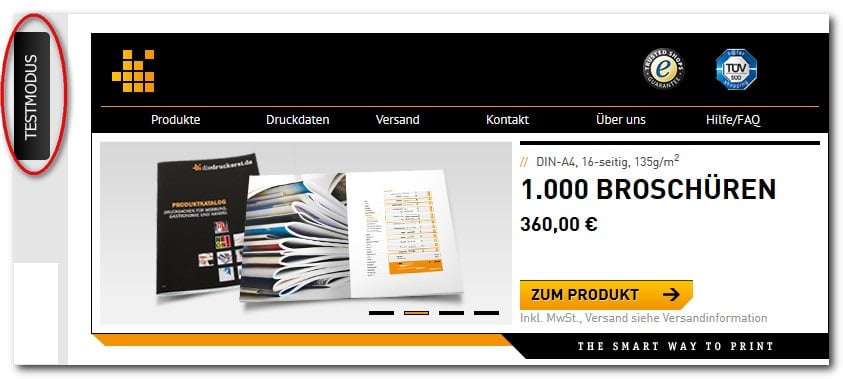
You can enable the general single test operation for your current session by appending the parameter?test=on to any shop call. A page opens with the input field for the password. After entering it correctly, the browser displays the originally called page; the shop is then in test mode.
Activate test mode:
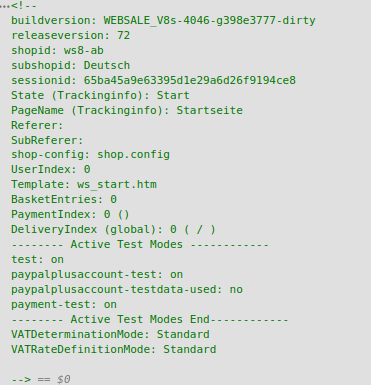
ST-TestMode bracket, you can output whether the shop is currently in test mode:
?test=off to any shop call.
Select individual test mode
Within the active general test mode, design adjustments and specific shop functions can be tested separately. It is also possible to combine multiple tests. Individual tests can be added or turned off specifically. To test special shop functions within the activated test mode, the following specific test modes are available.Design test mode
The design test mode is suited to specifically testing changes on the templates, for example adding banners. These changes can be added to the template using theST-DesignTest bracket.
Example:
?test=on, append the parameter &design-test=on to any shop call.
Activate the design test mode:
Campaign test mode
With campaigns, time-limited actions can be realized, for example special offers or free shipping. This test mode allows you to check the campaign settings in the shop configurationshop.config and the brackets set on the template.
Activate the campaign test mode:
Event test mode
Event brackets let you control when certain areas on a template should be displayed or not. You can test these brackets with a special test call. Suppose you have integrated the following event bracket on your templates:&event-test=<timestamp as specified in the argument of WS-Event> to any shop call; the shop must be in general test mode.
Activate the event test mode:
In the special case where the end time of one event and the start time of another event coincide, both event brackets are rendered in the event test mode when called with the corresponding timestamp. However, this only affects the test mode and does not apply in regular shop operations. There, the expired event bracket is immediately replaced by the starting event bracket.
Web2Print test mode
If the Web2Print feature is integrated in a shop, it can be tested with this mode. To activate, append the parameter&w2p-test=on to any shop call; the shop must be in general test mode.
Activate the Web2Print test mode:
A/B test test mode
With the A/B test module, the conversion rate of different versions of a shop page can be compared. To check the test cases of the A/B test module, this test mode is available. To activate, append the parameters&ab-test-id=<id> and &ab-test-case=<A-Z> to any shop call; the shop must be in test mode.
Replace <id> with the name of the test and <A-Z> with the letter of the respective test case.
Activate the A/B test test mode:
ABTest-active(Test-ID) tag can be used to display an area when the A/B test is active:
GeoIP test mode
With GeoIP brackets, you can display targeted information to customers from certain countries when they visit your shop. TheWS-GeoIPCountryCode() bracket is available for this.
Reference: WS-GeoIPCountryCode()
To activate, append the parameter &geoip-test=<3-digit ISO code of the country> to any shop call; the shop must be in test mode. The parameter &geoip-test=clear resets the GeoIP test country code. To exit, append the parameter &geoip-test=off; the GeoIP is then determined again based on the IP.
Activate the GeoIP test mode:
A test of the correct display of the alternative currency display based on the GeoIP is not possible with this test mode.
SSL-only test mode
The SSL-only mode, in which all pages of the shop are transmitted encrypted, can be tested with this mode. Activate the SSL-only test mode:Link optimization test mode
To test link optimization, first set theAllow parameter to the value test in the TopRank section of the shop configuration shop.config.
Activate the link optimization test mode:
Test mode for JavaScript and CSS minification
In conjunction with the WEBSALE V8s PageSpeed tool, two different test calls are available — one for choosing between minified and non-minified files, and one for direct access to the uploaded files.Test mode for using the minified or non-minified JavaScript and CSS files
If you are already using minified files in your shop, you can use the call&jscssminified-test=off to determine that the shop should access the non-minified files in the css_min and js_min folders. These files are provided by the PageSpeed tool at the same time as the minified files. This mode is helpful in order to more easily find and fix any errors.
Example:
jscssminified-test=on.
Example:
Direct access to the uploaded JavaScript and CSS files
When CSS and JavaScript files are included via the PageSpeed tool, a change only becomes visible after publishing the files. Under certain circumstances, this can be very obstructive during daily work. For this reason, you have the option of embedding CSS and JavaScript files directly and then testing them in the shop via a special direct-access link. To activate this direct-access mode, append the parameter&jscssdirect-test=on to any shop call.
Activate the test mode:
ST-DirectJSCSSTest tag can be used to display an area when the test with direct call is active:
Payment method test mode
WEBSALE provides a payment method test mode. You can use it, for example, if you want to integrate and test a new payment method in your shop without affecting the ongoing productive operation of the shop. In the template, theST-PaymentTest tag can be used to display an area when the shop has been called in the payment method test mode:
Setting up the payment method test mode for the desired payment method
In the<PaymentXXX-Txt> section of the respective payment method in the shop configuration shop.config, add the TestMode parameter and set it to yes:
Calling the shop in the payment method test mode
To activate the payment method test mode, append the parameter&payment-test=on to any shop call; the shop must already be in the general test mode.
&payment-test=off to any shop call.
Removing the payment method test mode for the desired payment method
After the test has been successfully completed, the payment method is to be actively used and offered in the shop. To do this, in the<PaymentXXX-Txt> section of the respective payment method in the shop configuration shop.config, set the TestMode parameter to no:
Test modes for individual payment methods
The following payment methods have their own test mode in addition to the general payment method test mode. For all of them, to activate the test mode theTestMode parameter in the shop configuration shop.config must be set to yes in the respective <PaymentXXX-Txt> section. To call the shop in the respective test mode, a third URL parameter is appended to any shop call, in addition to the general test mode ?test=on and the general payment method test mode &payment-test=on:
TestMode parameter is set back to no and the URL parameters to off.
For direct debit, an additional template tag is available. Using the
ST-DebitAccountTest tag, an area can be shown when the shop has been called in the direct debit test mode:
SEO URL test mode
WEBSALE provides an SEO URL test mode. You can use it to test the URLs you have changed in the TopRank Manager — that is, made more search-engine friendly — and to check their suitability by SEO standards. Put the shop into general test mode by appending the parameter&test=on and call the desired URL with the parameter &seo-urls-test=on, for example:
Test mode for offering shipping methods depending on the product
If you offer shipping methods depending on the product, you can check the necessary settings in the shop’s test mode. No special individual test mode is required for this. It is sufficient to call the shop in the general test mode; see the section Activate and deactivate test mode. Guide: Offering shipping methods depending on the productApp test mode
For faster debugging in the design, for example in case of display issues, WEBSALE provides a test mode that lets you activate or simulate the call of your WEBSALE app in the browser. Reference: WS-AppVersion Activate the app test mode:Combining different individual test modes
Within the active test mode, design adjustments and specific shop functions can be tested separately. It is also possible to combine multiple tests. Individual tests can be added or turned off specifically. Example for combining a design test and a campaign test:General test mode
In addition to the individual test mode described above, in which the shop can be tested during productive operation, the shop can be put into a general test mode. In this state, the shop can only be viewed after the password has been entered and cannot be found or visited by third parties. This is helpful, for example, when a separate subshop or an entire main shop is being prepared with a redesign. To do this, the shop is explicitly defined as a pure test shop in the shop configurationshop.config.
Set the parameter ShopActive-Allow to test in the <Basic> section of the shop configuration shop.config.
Alternative shop configuration for tests
You have the option of calling the shop for test purposes with an alternative shop configuration. This is useful for testing settings in the shop configuration that do not have their own test switch. This is the case with shipping methods, for example. Create a new shop configuration with the settings you want to test. How to do this is described in the guide Editing configurations. To call the shop with the alternative shop configuration, append the parameter?shop-config=<name-of-the-alternative-shop-configuration>.config to the shop URL, with the file name of the alternative shop configuration as the parameter value.
Example:
shop.config is used again.
If necessary, you can also combine the alternative shop configuration and test mode.
Example:
Changes to programs that are called via
ExternInclude or ExternModule (WS-Module()) cannot be tested with an alternative shop configuration. The programs know nothing about this alternative shop configuration, since the relevant information is not passed on by the shop when called.